


Views: 0 Author: Site Editor Publish Time: 2026-05-21 Origin: Site


Modern data centers require more than just strong flooring panels. A professionally engineered raised floor system plays a critical role in supporting heavy server racks, improving airflow management, and ensuring long-term operational reliability.
As AI computing, cloud services, and high-density server deployments continue to expand, selecting the correct raised floor system has become increasingly important for data center designers, contractors, and facility operators.
Today’s server environments demand flooring systems capable of supporting higher equipment loads while maintaining efficient cooling airflow beneath the floor. An optimized raised floor system helps improve thermal performance, reduce energy consumption, and provide flexible infrastructure management for future expansion.Huilian has been delivering premium raised floor solutions since 1999. We help you build high-performance spaces that stay cool and run efficiently.
In this guide, we explain how raised floor load capacity, airflow performance, and material selection affect the safety and efficiency of modern data center environments.
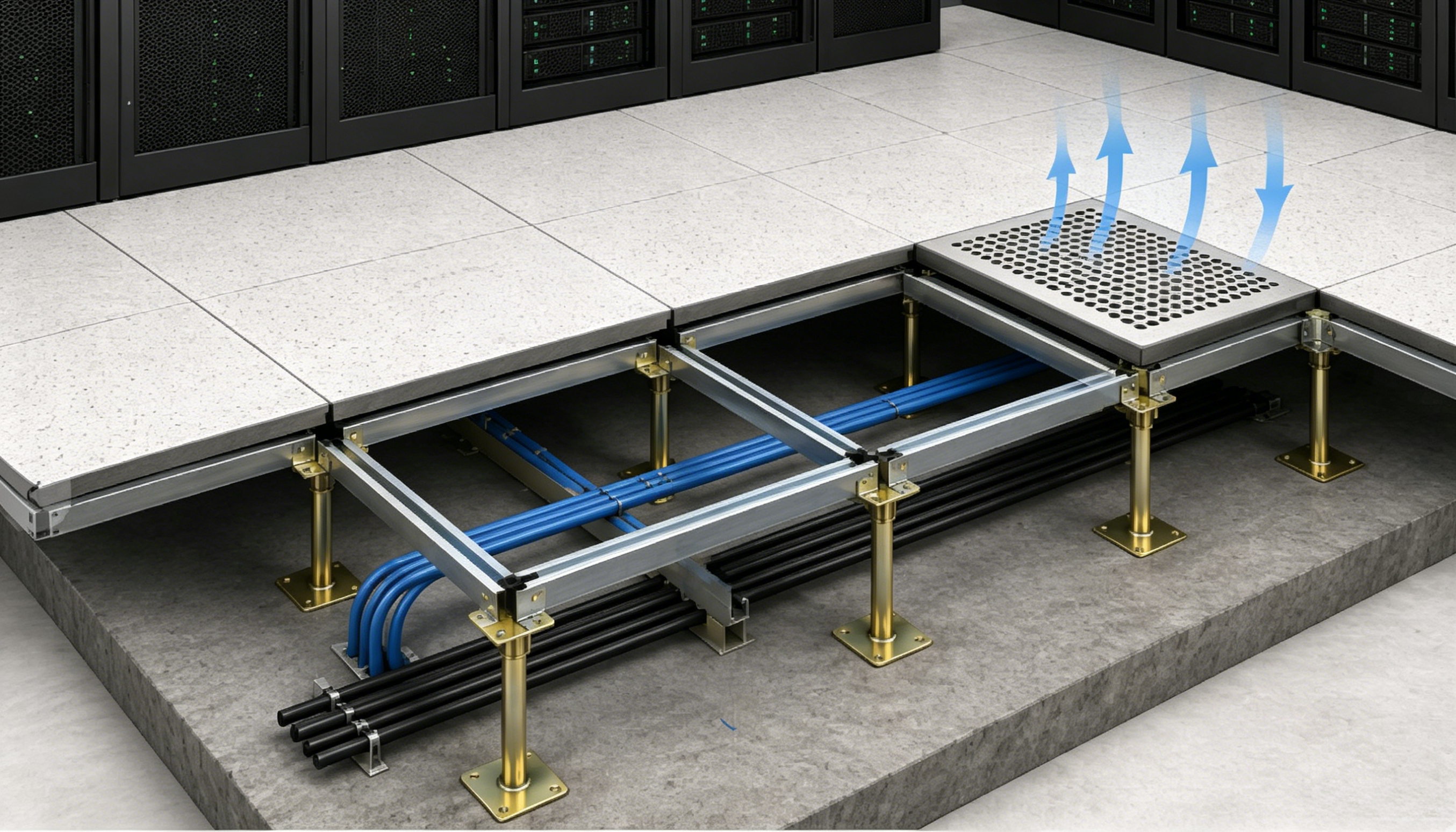
A data center raised floor system is an elevated flooring structure installed above the concrete slab to create an underfloor plenum space. This underfloor area is commonly used for:
Cold air distribution
Power cable routing
Network cable management
Fire suppression systems
Flexible infrastructure upgrades
A typical raised floor system includes:
Steel pedestals
Stringers
Raised floor panels
Perforated airflow panels
Modern raised floor systems are widely used in:
Enterprise data centers
Hyperscale facilities
Telecom rooms
Cloud computing centers
AI server rooms
Compared with traditional flooring systems, raised access floor systems provide better flexibility, cooling efficiency, and equipment accessibility.

The increasing use of AI GPU servers and high-density computing equipment has significantly changed the structural requirements for modern raised floor systems.
Today’s server racks often include:
GPU clusters
Liquid cooling systems
Large battery backup units
High-density storage devices
As a result, cabinet weights continue to rise.
In some AI data centers, fully loaded racks may exceed 2,000–3,000 lbs (900–1360 kg). During installation or maintenance, rolling equipment can generate even greater stress on the floor system.
If a raised floor system does not provide sufficient load capacity, potential problems may include:
Panel deformation
Structural instability
Excessive deflection
Vibration issues
Cooling inefficiency
Equipment safety risks
For mission-critical facilities, selecting the correct raised floor system load rating is essential for long-term operational stability.
Raised floor system performance is typically evaluated according to CISCA or EN 12825 testing standards.
Several different load ratings are used to measure floor strength and durability.

Static load refers to the maximum stationary weight that a raised floor panel can support.
This rating is especially important for permanently installed server racks and heavy IT equipment.
Typical static load capacities include:
Raised Floor Application |
Static Load Capacity |
Standard Office Raised Floor |
800–1000 lbs |
Enterprise Data Center Raised Floor System |
1250–1500 lbs |
High-Density AI Data Center Floor System |
2000–3000+ lbs |
A high-quality raised floor system should maintain structural stability under continuous heavy loading conditions.
Point load measures the pressure applied to a concentrated contact area such as server rack feet or equipment casters.
Point load performance becomes increasingly important in AI server environments where equipment weight is highly concentrated.
Even when the total floor load appears acceptable, insufficient point load capacity may still lead to panel damage or structural failure.

Rolling load evaluates how well a raised floor system withstands moving equipment across the floor surface.
During installation and maintenance, heavy cabinets and UPS systems are often transported using wheels or casters.
Poor rolling load performance can result in:
Surface damage
Panel fatigue
Structural weakening
Reduced service life
Modern raised floor systems for data centers must be engineered to handle both static and dynamic loading conditions.
Ultimate load refers to the maximum load a panel can withstand before structural failure occurs.
In practical engineering applications, a safety factor is normally applied to ensure long-term reliability and operational safety.
Different data center environments require different raised floor system performance levels.
Application |
Recommended Load Capacity |
Small Server Room |
1000–1250 lbs |
Enterprise Data Center |
1250–1500 lbs |
Telecom Facility |
1500–2000 lbs |
AI GPU Server Room |
2000–3000+ lbs |
Hyperscale Data Center |
Custom Engineered |
When selecting a raised floor system, engineers should also consider:
Rack footprint
Weight distribution
Rolling load frequency
Future expansion plans
Seismic requirements
Cooling system configuration
Besides structural support, a raised floor system also plays an important role in data center cooling efficiency.
In traditional airflow designs, cold air generated by CRAC or CRAH units is distributed through the underfloor plenum and delivered into server aisles through perforated floor panels.
This cooling method helps:
Improve thermal management
Reduce hot spots
Stabilize server temperatures
Lower energy consumption
Improve PUE performance
Efficient airflow management has become increasingly important in high-density AI and cloud computing environments.
Several factors influence airflow performance beneath a raised floor system.
A deeper underfloor plenum generally improves airflow distribution and pressure stability.
Common raised floor heights include:
300 mm
600 mm
900 mm+
Large hyperscale facilities may require even greater plenum depths to support advanced cooling infrastructure.
Perforated raised floor panels regulate the amount of cold air delivered to server cabinets.
Common panel configurations include:
25% open area
45% open area
High-airflow grate panels

Correct panel placement is critical for maintaining balanced airflow throughout the data center.
Modern raised floor systems are frequently integrated with:
Hot aisle containment
Cold aisle containment
Precision cooling systems
CFD airflow optimization
This integrated cooling strategy helps improve energy efficiency while supporting high-density rack deployments.
Several raised floor panel materials are commonly used in modern data center environments.

Steel Concrete panels are among the most widely used options because they provide:
High load capacity
Excellent durability
Good fire resistance
Stable performance
Competitive cost
These systems are widely used in enterprise and hyperscale facilities.

Calcium sulfate panels offer:
Excellent fire performance
Environmental sustainability
Good acoustic insulation
Anti-static properties
They are commonly selected for premium IT and control room environments.

Aluminum panels provide:
Lightweight construction
Corrosion resistance
High dimensional precision
Excellent airflow compatibility
These systems are often used in clean rooms and specialized technical environments.

AI infrastructure is changing the design requirements for modern raised floor systems.
Today’s GPU clusters generate:
Higher rack densities
Increased floor loading
Greater cooling demand
More complex cable management requirements
Some AI server racks may exceed 30kW, 50kW, or even 100kW per rack.
As a result, modern raised floor systems must support:
Higher concentrated loads
Enhanced rolling load performance
Liquid cooling compatibility
Advanced airflow optimization
Long-term infrastructure scalability
Future-ready data centers increasingly require customized raised floor engineering solutions rather than standard office flooring products.
Underestimating server rack weight can lead to structural problems and expensive upgrades later.
Many raised floor failures occur during equipment transportation rather than normal operation.
Incorrect perforated panel placement may create cooling inefficiencies and server hot spots.
Low-cost raised floor systems may not meet the performance requirements of mission-critical data center environments.
Jiangsu Huilian Access Floor Co., Ltd. specializes in manufacturing high-performance raised floor systems for data centers, commercial buildings, and high-tech facilities worldwide.
Our raised floor solutions are designed to meet the requirements of modern IT infrastructure, including:
High load capacity raised floor systems
Steel cementitious panels
Calcium sulfate raised floors
Perforated airflow panels
Customized OEM and ODM solutions
With advanced manufacturing equipment and strict quality control procedures, Jiangsu Huilian provides reliable raised floor systems for demanding data center applications around the world.Our 200,000 sqm facility and 500+ staff ensure timely delivery for hyperscale projects.
We support global customers with:
Technical consultation
Customized engineering support
Export packaging solutions
International project experience

A professionally engineered raised floor system is essential for modern data centers, especially in high-density AI and cloud computing environments.
By selecting the correct raised floor load capacity, airflow configuration, and panel material, operators can improve cooling efficiency, increase structural reliability, and support future infrastructure expansion.
As server rack densities continue to rise, investing in a high-quality raised floor system becomes increasingly important for ensuring long-term operational safety and performance.
A raised floor system is an elevated flooring structure used in data centers to support equipment, distribute cooling airflow, and organize cables beneath the floor surface.
Most enterprise data centers use raised floor systems rated between 1250 lbs and 2000 lbs, while AI and hyperscale facilities may require 3000 lbs or higher.
Rolling load measures how well a raised floor system withstands moving equipment such as server racks or UPS units transported on wheels or casters.
Yes. Although some hyperscale facilities use slab cooling designs, raised floor systems remain widely used for airflow management, cable routing, and flexible infrastructure deployment.
Steel cementitious raised floor systems are widely used because of their strength, durability, and cost-effectiveness. Aluminum and calcium sulfate systems are also used for specialized applications.
Typical raised floor heights range from 300 mm to 900 mm depending on airflow requirements, cable density, and cooling system design.


